
STEM
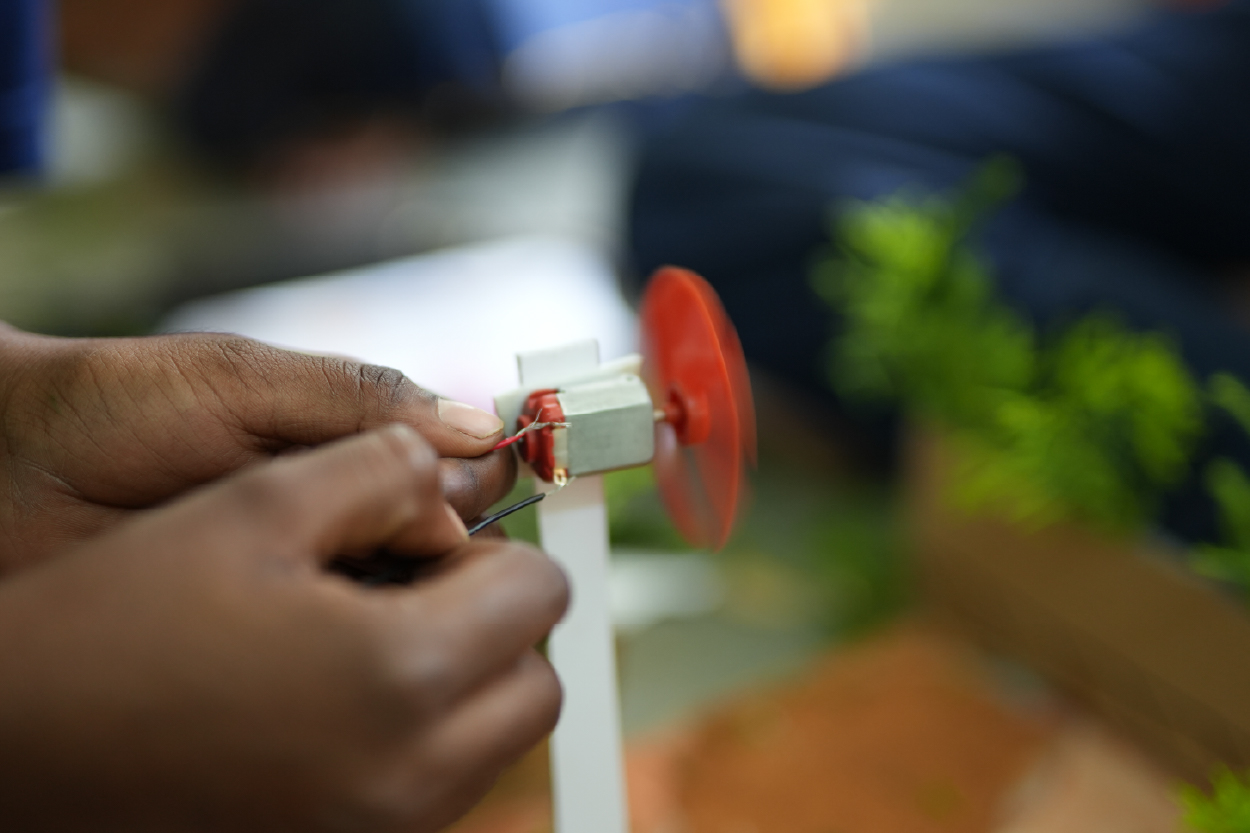
In partnership with Quest Alliance and with funding from IBM, we work with 800+ government schools in rural and underserved communities, and have designed a STEM club curriculum which interweaves STEM learning with questioning gender stereotypes. We also conduct capacity building of teachers in the schools to facilitate our educational interventions. Additionally, we conduct regular STEM hackathons in the schools.
Intersectional STEM curriculum
We've created an intersectional STEM curriculum for STEM clubs in the 800+ government schools we work with, which takes into account the unique cultural contexts of the students, and weaves activity-based STEM learning with questioning gender stereotypes and reworking gender-norms among students. The curriculum is for a year-long STEM club program, and is implemented through 3 activity-based guides we've written - the teacher's handbook, the facilitator's handbook, and the student's handbook. Care is taken to use the simplest possible English in the material, and translations to various other Indian languages are in the works. We have also built in degrees of freedom within the curriculum, so that students from vastly diverse backgrounds can adapt the curriculum and guides to their own cultural contexts. Below are a few examples of this from the teacher's handbook.
Green-practices snakes and ladders game
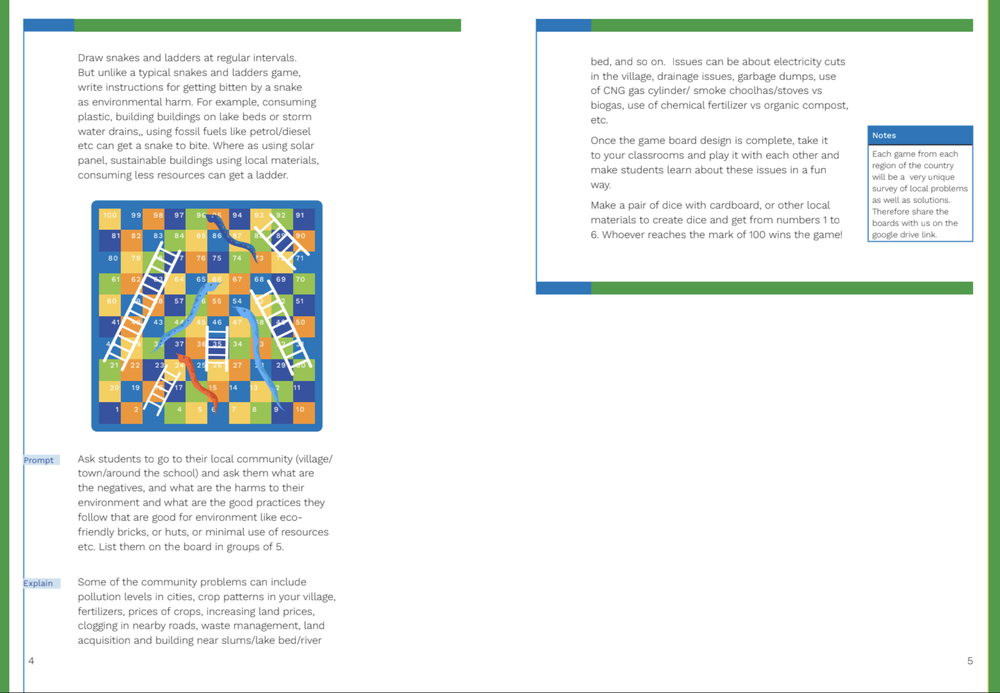
Students design a snakes and ladders board game, with the snakes being the environmentally harmful practices, and the ladders being the environmentally beneficial practices, all within the unique contexts of their own cultures and localities. To figure out what the eco-friendly and eco-unfriendly practices in their vicinity are, the students interview people in their village. At the end of the activity, the students enjoy the game of green-practices snakes and ladders on the board they've themselves created. These boards from various different parts of India serve as interesting windows into the various unique practices in the vastly diverse parts of India.
Questioning superstitions
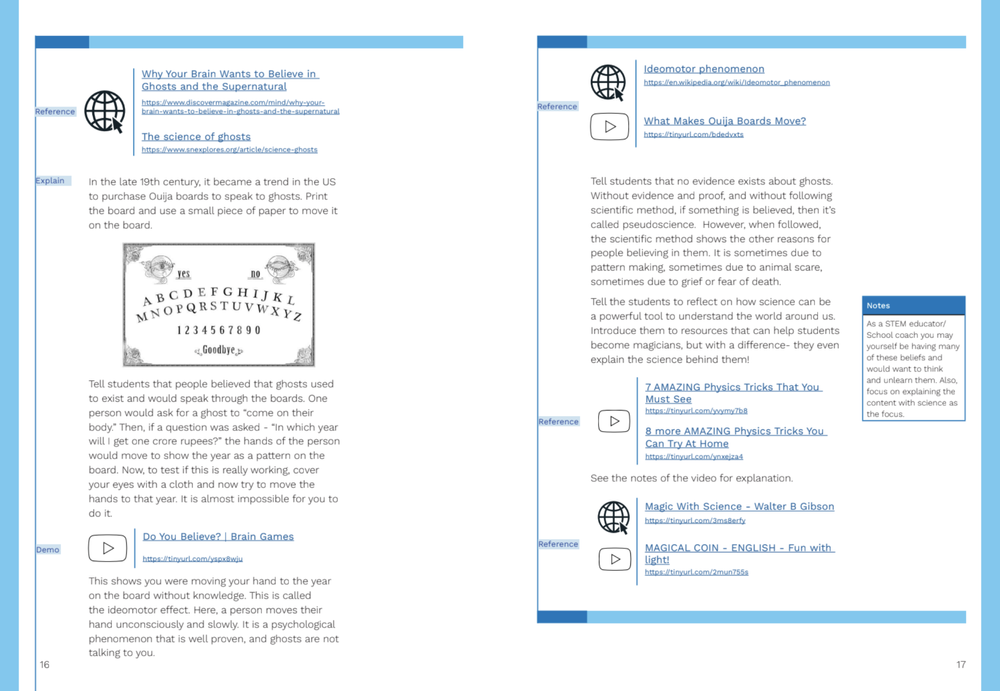
Students learn about the Ouija board — a board used to speak to ghosts — which became popular in the US in the late 19th century. They then try speaking to ghosts with funny question prompts, first without a blindfold on, and then with a blindfold on. The aim is for them to discover that while coherent answers are provided by the so-called ghost when the students don't wear blindfolds, the answers are all random when they have blindfolds on. The session concludes with them learning about the ideomotor effect and finally reflecting on what superstitions they can question in their unique cultural contexts.
Gender riddle
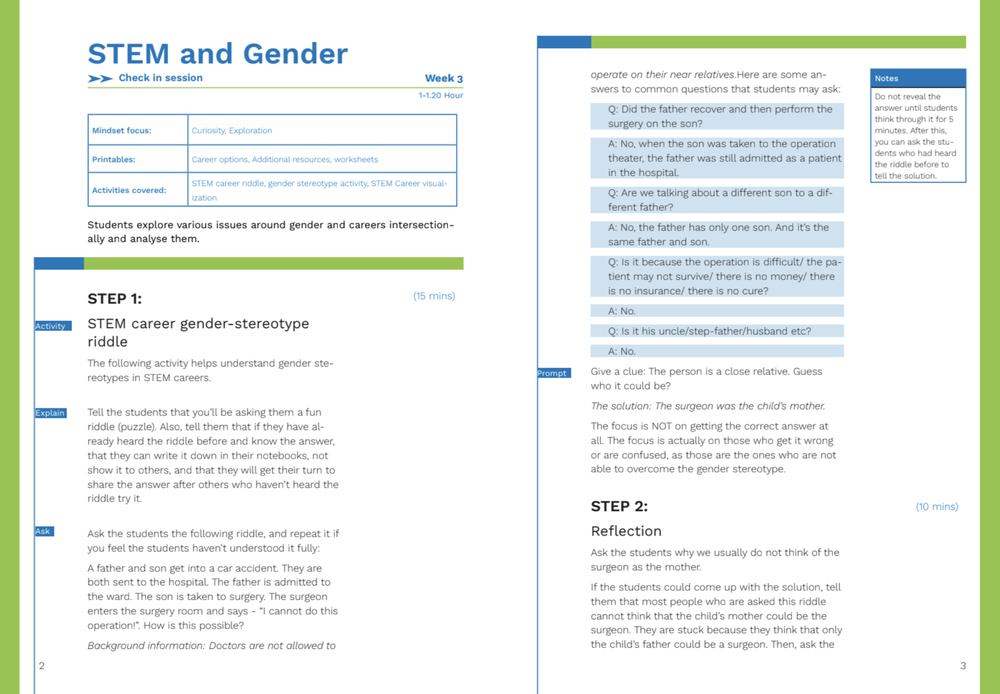
Students are asked a riddle that has been shown to expose gender-stereotypes. The students then reflect on how those stereotypes are artificially reinforced, and instances in which they are skirted or broken, in their own unique cultural contexts.
STEM Hackathons
In the STEM hackathons, the girls choose what they want to build, have great fun building, gain confidence in their ability to build, and in the process, questioning any self-directed gender stereotypes, by building their own capacities and confidence to work in STEM.
Our hackathon outcomes can be classified into three categories - tech-oriented, semi-tech-oriented, and low-tech. Kids are not pushed to choose to build things using a microcontroller (tech-oriented) or even a wire (semi-tech-oriented) if they don't want to - they can still learn a lot and have great fun by engaging in low-tech builds like making brooms from scratch by collecting large amounts of dried grass from around them, cutting them carefully, brushing them, and typing them up in just the right way. This lack of undue pressure creates a safe space where the kids can freely explore STEM and experience the joy of building, while putting themselves out of their comfort zone and feeling empowered in the process.